Braised and Broiled Beef Tongue

Braised and then Broiled Beef Tongue set on top of Chayote Squash

(Harini’s version of Empal Lidah – Origin: East Java)

For serious meat lovers, beef tongue has been known for its tenderness and succulence. Jeff “introduced” me to this meat a few years back. He ordered a delicious beef tongue dish (I don’t recall the name now) once when we dined at Chicago’s Colombian restaurant, Las Tablas (on Lincoln Ave.), and then again at El Llano (also on Lincoln). He said that the plate reminded him of a couple of Indonesian dishes he enjoyed so much: braised and pan-seared beef tongue and a beef tongue stew. I had never tried these dishes before and was intrigued. Jeff’s story  inspired me to make the braised and pan-seared one. The only difference I did was that after braising, I broiled the meat instead of pan searing it. Jeff and I would have this dish every now and then. When we have it, I usually pair it with a chayote squash in spicy broth and serve them together over white jasmine rice.
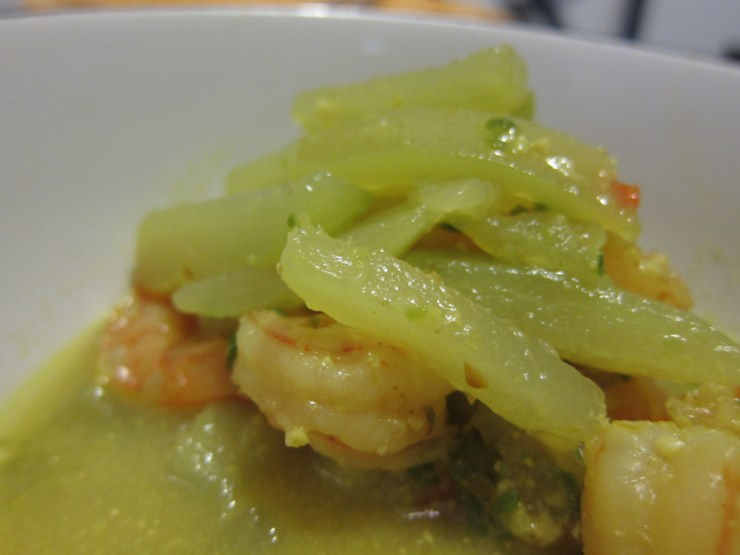
Chayote squash in spicy broth with shrimp (optional)

The way I like to cook beef tongue is to make the meat to be tender in the inside and crispy on the outside. Braising the meat for at least two hours and then broiling it a little bit inside of an oven work for my preference.

Here’s how I cook the meat:

First we will need:

  • 2 pounds of sliced (skinless) beef tongue. A little note about beef tongue for those who have never cooked it before: some grocery stores meat department may only carry the whole meat (not sliced).  If so, you’d have to remove the skin and fat by cooking the whole meat in a large pot for about 30 minutes, remove and let it cool, chop it into big chunks, and then cut off the skin and fat. The skin comes off easier when the meat is hot.
  • 2 cups of white vinegar

Chop and mix in a food processor:

  • 1 tablespoon of minced garlic
  • 6 shallots
  • 6 candlenuts
  • 1 teaspoon of coriander powder
  • 1 teaspoon of ginger powder
  • Salt
  • Black pepper

For aroma:

  • 1 Lemongrass (Cut and throw away the very top and bottom part and then halve it)
  • 2 lime leaves
  • 1 inch of galangal root

Steps:

  • Place the whole meat in a large pot and cover it with water
  • Bring to boil and let cook for 30 minutes and then dump the water
  • Put the vinegar in a larger bowl that can be used to soak the meat
  • Cut the whole meat into larger chunks
  • Cut off the skin, trim away the fat, and throw them away
  • Slice the meat into 1/2 inch thick
  • Wash with water and then soak them in the vinegar bowl for 10 minutes and then drain
  • Return the meat in the larger pot and cover it again with water over medium heat
  • Add the chopped and mixed spices from the food processor along with lemongrass, lime leaves, and galangal root
  • Stir and mix well
  • Cover with a lid and let it cook for about 1 ½ to 2 hours or until liquid is reduced by ¾
  • Place the braised meat on an aluminum-foil-layered tray, broil in the oven with the door slightly ajar for about 5 minutes or until the outer part of the meat turns golden brown
  • Best served with white jasmine rice

Serve 4
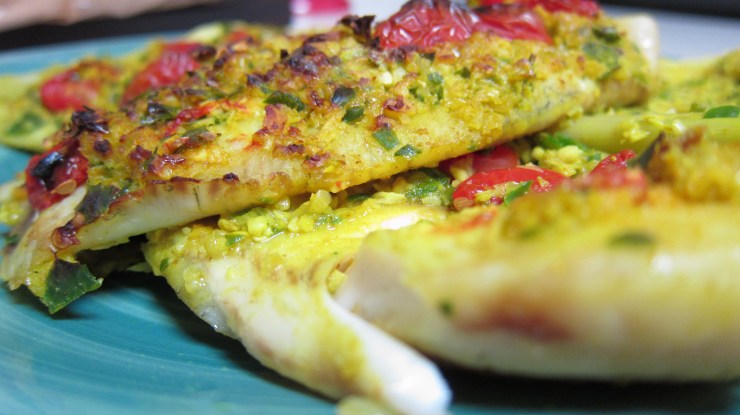
Spiced Up, Steamed, and Broiled Tilapia

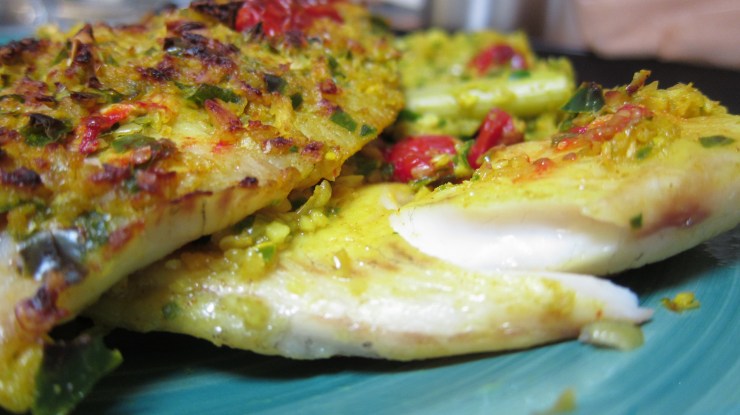
Super delicious Tilapia!  This spiced-up Tilapia dish offers this wonderful lemony aroma. The presence of tomatoes and shallots provide a little sweetness while the thick chilies gives a wonderful punch to the dish.

Harini’s Version of Pepes Ikan, Origin: Java Island, Indonesia

I love seafood. As a big fan, I enjoy trying and learning about the different cooking methods that enhance seafood’s delicious taste.

The other day I felt like preparing something light. I grabbed a bag of frozen Tilapia fillets from the market and started to think about ways to prepare them. Tired of grilling and pan-searing, which I often do, I decided to do something different with the fillets. I covered the Tilapia fillets with chilies and spices, wrapped them in foils, steamed, and then broiled them. In Indonesia, this cooking method is simply called Pepes (while Ikan means fish). Traditionally though the method calls for wrapping a spiced-up whole fish in the aromatic banana leaf, steaming, and then grilling it on top of a charcoal grill. (Aside from serving as a wrap to let the fish cook well with the spices without falling apart, banana leaf also adds its sweet aroma to the fish.) Then to serve, simply unwrap and discard the banana leaf and enjoy the fish.

My sister and I made this dish for the first time when she visited a while back. I remembered her copying a recipe she found online and walking me through it while I cooked. The rest of the family was arriving that night so we wanted to welcome them with several of our favorite native cuisines. We successfully filled the apartment with an amazing cooking aroma and the dining table with delicious food. Everyone was delighted.

This time I went with a few tweaks to simplify the method: I used fillets instead of a whole fish, I went with aluminum foil (since I already have this available) instead of banana leaves to wrap the fillets, and instead of grilling the fish on a charcoal grill out in the snow, I simply unwrapped the fillets and broiled them.

I adapted my version below from two recipes I found at Merry’s Kitchen of Indonesian Cuisines: Pepes Ikan Mas (In Bahasa Indonesia, not available in English. Use translate.google.com to see translation.) and Steamed Fish Wrap in Kemiri Nut Sauce.

Here’s how I do mine.

Ingredients:

  • 4 Tilapia fillets (I am sure light and fluffy white fish like Halibut, Sea Bass, and Red Snapper would work great too. But those could get very expensive if you cook fish as often as I do. So Tilapia gets to be a great and an economical alternative for me.)
  • 1 lemon

Prepare the chilies in a food processor:

  • 1 teaspoon of turmeric powder
  • 7 shallots
  • 2 tablespoon of minced garlic
  • 10 hot finger peppers (I actually used 15 and it was very spicy! So please adjust accordingly.)
  • 1 inch of ginger (peeled)
  • 6 Candlenuts (they make a wonderful thickening agent for chilies or sauces)
  • Salt

For the aroma, cut and halve

  • 1 Lemongrass (I cut into two sections and then halved. I also threw away the very top and bottom part of it.)
  • 4 Bay leaves
  • 1 inch of Galangal root (peeled and halved)

Add:

  • A cup of grape tomatoes (halved) or 1 medium size tomato (diced)

Preparation:

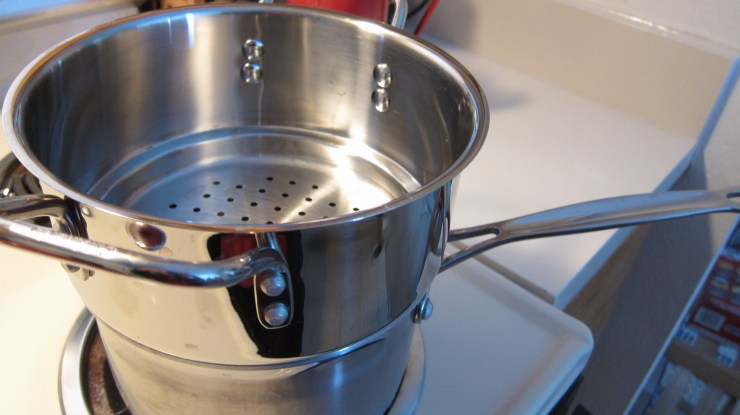
  • Place your steamer on top of a pot of boiling water.
  • Prepare two sheets of aluminum foil (maybe like 12 X 17)
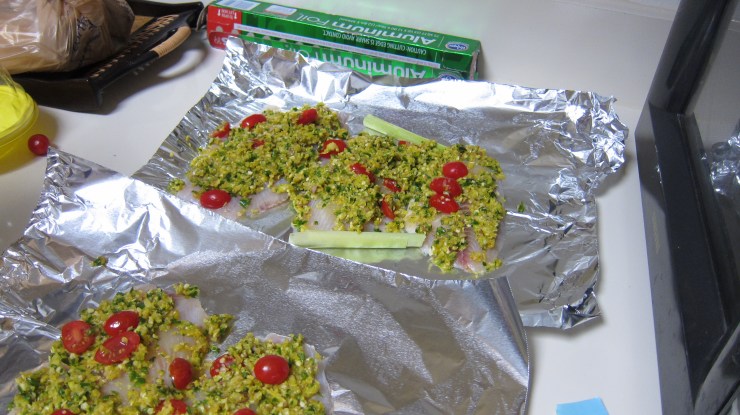
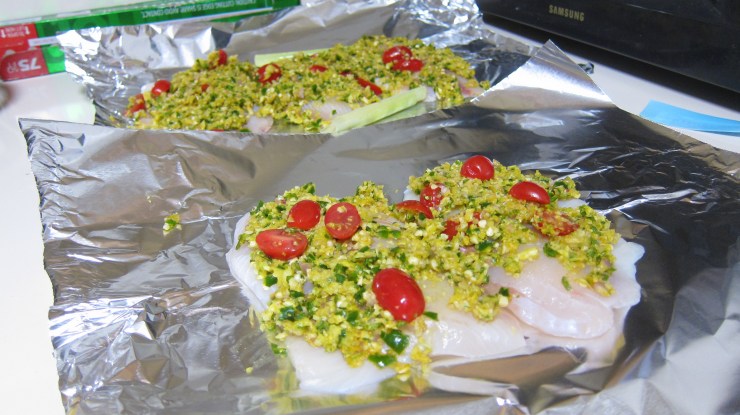
  • Place two fillets on each foil. Drizzle and coat with lemon juice.
  • Cover the top of the fillets with the chilies from the food processor. Add the cut up tomatoes.
  • Divide Lemongrass, Galangal root, and Bay leaves into equal amount for each sheet and place them on the fillets
  • Wrap them up (chili-covered side facing up), place the two packages in the steamer, cover with a lid, and let them steam for 20 minutes.
  • After 20 minutes, set the oven to broil and unwrap the packages (don’t remove the fillets).
  • Put the opened packages on a larger tray (to make it easier to handle) and then place it into the oven to broil for about 5-10 minutes.
  • Leave the oven door slightly ajar (a couple of inches) to allow moisture from steaming to escape and also to avoid burning the spiced up fish.
  • Take the tray out once the spices on the top of the fish and the edges of the fillets get dry and turn brown.
  • Let the fillets cool down a bit before serving.
  • Best served with white jasmine rice.


Serve 2-4 people


Braised and Broiled Chicken Thighs

As a big-flavor food enthusiast, I see chicken as a great “blank canvas” in my cooking. The meat has great potential for many delicious dishes. With the right blend of spices and a little patience anyone can create their own far-from-boring signature chicken dish. For me, braised and broiled chicken has been an all-time favorite and specialty.

Inspired by a version (out of many) of traditional Javanese grilled chicken, I learned to cook this meal by trying on different recipes years ago. I tweaked the technique and ingredients many times to get to my own version. We evolved with time, the recipe and I. Now that I have reached my satisfactory level with this dish I feel more confident in sharing the recipe with others. 

Chicken thighs with their succulence and tender texture work best for this particular recipe. The meat doesn’t turn dry even after being cooked twice. In this recipe I braise the chicken to tenderize the meat and infuse it with flavors of my choosing. Then I broil the braised meat to get that crispy golden brown effect on the chicken’s exterior. (During the warmer months I’d brown the braised chicken on a grill outside.)

Here are the must-haves and the steps to cook the chicken:

  • 4-6 bone-in and skin-on chicken thighs. (Worry not about the fat. A lot of it will be cooked out of the meat.)
For the lemon-like aroma, smash:
  • 1 inch of galangal
  • 1 lemongrass
  • 2 kaffir lime leaves (optional)

For the flavor, mix and puree in a food processor:

  • 1 inch of ginger
  • 1 tablespoon of minced garlic
  • 4-5 shallots
  • 5-6 candlenuts
  • 1 teaspoon of coriander powder
  • ½ teaspoon of turmeric powder
  • ½ teaspoon of black pepper powder
  • 1 tablespoon of cayenne pepper powder
  • Salt (be generous)

Heat up a tablespoon of canola oil in a large pot (over medium heat). Brown the blended spices along with the galangal and the lemongrass. Add the chicken and two or three cups of water (until the chicken is almost, not completely, covered by the liquid). Stir and mix well. Throw in the kaffir lemon leaves. Cover with a lid and let it cook for an hour to an hour and a half until the meat gets tender. Taste before broiling. Add more salt if necessary. (Leaving the chicken in its braising liquid overnight, and broil the next day, would amplify the taste.)

Final step:

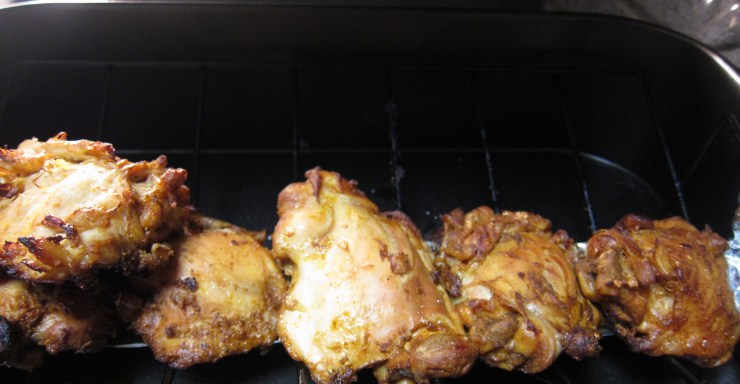
Set oven to broil. Place the chicken thighs on an oven rack set over a tray (so that any leftover juice has a place to go). Broil each side for 4-5 minutes until the color turn to golden brown. Be careful, it’s super hot!

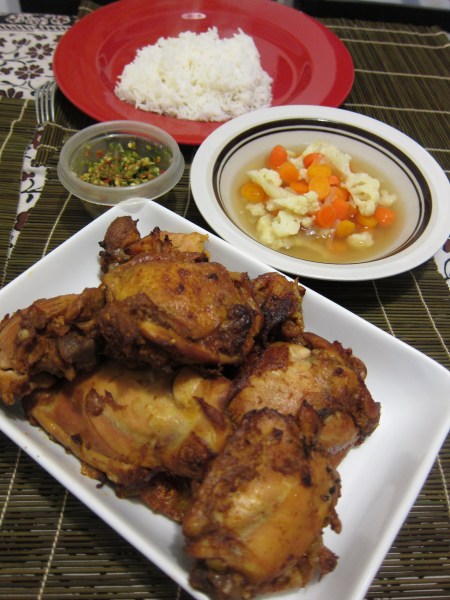
Great with steamed white rice, chilies, and a vegetable soup side dish (coming up on the blog soon).

Serve two generously